


FOR CAFÉS & COFFEE SHOPS
The queue is the business. Keep it moving
A café lives on small tickets taken quickly. Every extra tap between "flat white, oat" and the card going in is a person deciding whether to wait. So the till has to be fast, the card has to be one tap, and nothing in the morning rush should need a manager.
Sound familiar?
Eight people deep at half past eight and the till needs three taps for a coffee.
Someone asks what is in the banana bread and nobody is sure.
Payroll day means adding up scribbled hours from a notebook.
What changes
Your bestsellers first, in your own order and colours, with sizes and add-ons on the same screen — a coffee is one tap, not three
Contactless, Apple Pay and Google Pay, on a card machine that can be the till itself
Seated guests order another round from the QR code on the table — no queue
Gift cards and vouchers, sold online and redeemed at the counter
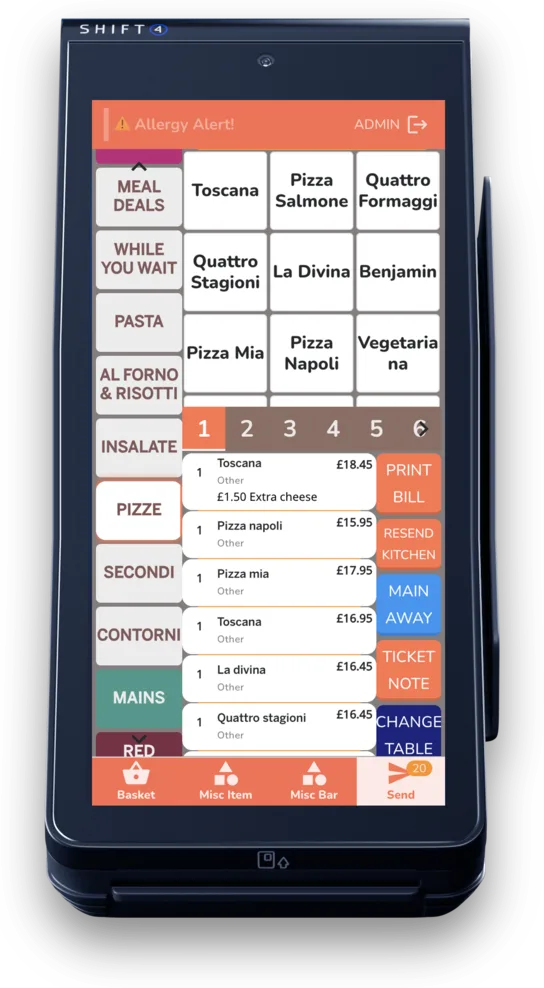
A guest’s allergy flagged on the order prints in the kitchen and shows on the display
Staff clock in and out on the till, or on a clock-in tablet of their own; hours go straight to payroll
One service, start to finish
- 7:30
The team clock in on the till. No notebook, no honesty system.
- 8:30
The rush. Bestsellers first on the screen, tap to pay, next.
- 11:00
Seated guests order a second coffee from the table QR while the counter catches its breath.
- Close
One Z-report, cash counted against what the till expected, hours already logged.
Seconds per order is the whole game
A café at peak is a throughput problem. If the average order takes eight seconds instead of fourteen, the queue at half eight is half as long, and the people who would have walked past stay. That is the only performance number worth optimising for, and it comes from boring things: your bestsellers where your thumb already is, modifiers that do not open a second screen, and a card terminal that does not need the total typed into it twice.
Let the people sitting down skip the queue
A café’s second order often comes from someone already at a table. The QR code on the table lets them order another flat white and pay from their own phone without joining the queue, and the counter keeps serving the people who want to talk to someone. Orders from both go to the same kitchen printer and display; QR orders also show in their own list on the till. A self-service kiosk is coming soon.
The questions you get asked all day
When a guest mentions an allergy, whoever is on flags it on the order, and it prints on the kitchen ticket and shows on the kitchen display: in writing, not in a folder under the counter. With Inventory, allergens are recorded on each ingredient and your allergen labels are built from the recipes. That is the part of Natasha’s Law that is easy to get wrong when it lives in someone’s memory.
See it before you decide
The user guide shows what each app does: start with Yumee Restaurant and Yumee Metric. To see the screens themselves, book a demo and we will show you on your own menu.
Guides for cafés
Free guides based on official sources: VAT on takeaway food, allergens in restaurants, QR order and pay at the table, opening a takeaway, Natasha’s Law labels, pavement licences and data protection and CCTV. All of them are on the guides page.
The setup that usually fits
Tabteck Trio
A tablet till, a card machine and a receipt printer. It takes up almost no counter, which is exactly where a café is short of space.
See the packageSo what does it cost?
The software is a monthly licence per device, excluding VAT — call us on 0330 122 7312 for a price. Hardware, installation and card processing are quoted separately — all of it in writing, with nothing appearing later.
Get a quoteRun something else?
Let us work out if it fits
Tell us what you run and we will tell you honestly which of this you need — and which you do not.
Phone
0330 122 7312
info@yumeeservices.com
Location
The Charter Building
Charter Pl, Uxbridge UB8 1JG